Certificated Welding Inspector (CQVP Part 1)-Virtually Live
Introduction to Welding Process, Welding Symbols. Visual inspection of Welded Joints in Pipes, Fabricated Structures, Pressure Vessels, Flow Lines, and Pipelines
Course Overview
Invest in a Skill That Builds the World
From steel structures and industrial plants to offshore platforms and pipelines, welding inspection professionals play a crucial role in ensuring safety, quality, and reliability.
If you want to build a strong career in engineering inspection, quality assurance, and industrial projects, this course is your gateway.
Welding Inspection (CQVP Part1)
This Practitioner Level 40 hours course has been designed by TCB to provide knowledge and skills in Welding, Symbols, Joint Design, WPS, PQR, Material testing, and Associated NDT. Upon completion of this part you will appear for an examination and practical assessment which will fulfill the first part of CQVP course and achieve TCB Certified Welding Inspector qualification .
What course Covers
- Introduction to Welding
- Welding, Process. SMAW(MMAW), GTAW(TIG), SAW, GMAW(MIG)
- Welding Symbols and Joint Preparation.
- Electrodes and Manufacturing process
- Welding Procedures Specification, Welders Qualification test and Certification.
- Mechanical (Tensile, Bend, Charpy),Chemical (Spectro) and Metallurgical Testing (HIC, SSC) for material certification
- Quality Control and Assurance in Welding and Fabrication-Application of ISO 9001:2015 in Fabrication and Welding Inspection
- Fundamentals of Basic Nondestructive Testing
- Inspection of welding -Practical (Plates and Pipes) against ASME /API Requirement and Practical.
- Written Examination
What You Will Learn
This hands on training covers the essential theory and practical application of visual inspection, preparing candidates for a recognized industry certification exam. You will develop and Skills in the following key areas of study which include:
- Welding Technology Fundamentals: A review of common welding processes (e.g., SMAW, GMAW, GTAW), welding terminology, and joint types.
- The Role of the Inspector: Understanding the duties and responsibilities of a visual welding inspector before, during, and after welding operations.
- Codes and Standards: An appreciation of the necessity for specifications, codes (e.g., AWS, API, or ISO/EN standards), and the application of specified acceptance criteria.
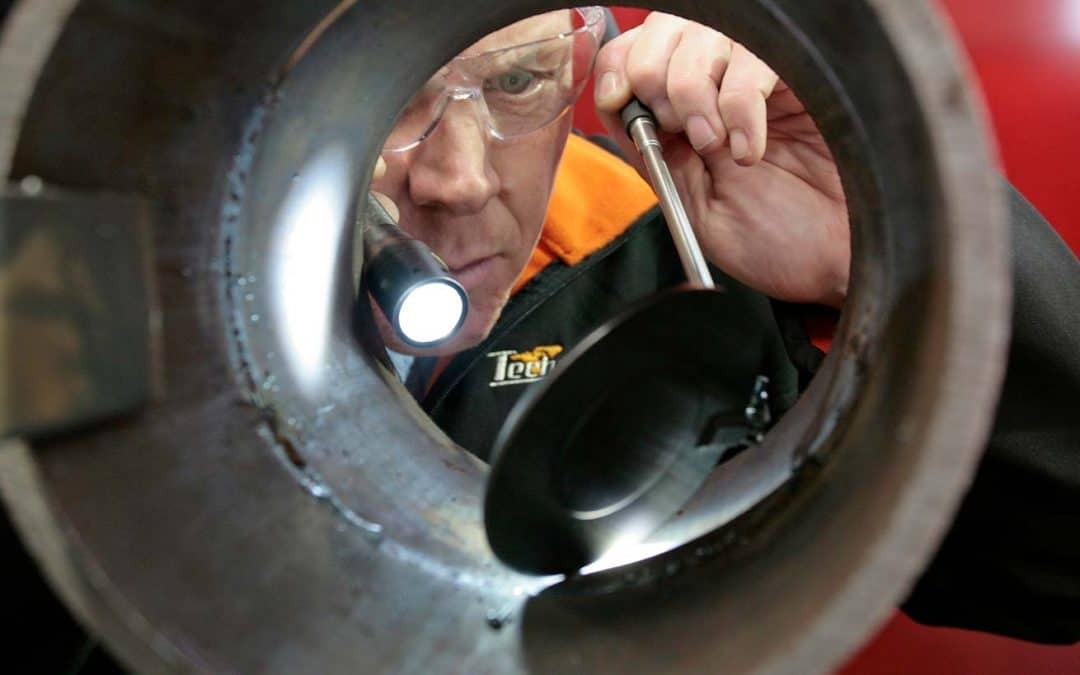
- Inspection Tools: Hands-on training with welding inspection gauges and other standard measuring devices used for checking fit-up and finished weld profiles.
- Weld Imperfections: Correctly identifying, classifying, and evaluating various weld imperfections and defects (e.g., porosity, crack, lack of fusion, undercut) against specified acceptance levels.
- Documentation and Reporting: Learning to prepare accurate and comprehensive inspection reports and understanding the need for proper documentation control.
- Materials and Welding Consumables: Checking and verifying the correctness of parent materials and welding consumables in accordance with specifications.
Eligibility Requirement:
Graduates in Mechanical Engineering, Production Engineering, Technical Diplomas or Science Graduates (with Physics , Chemistry or Mathematics) are eligible to attend this course. Good proficiency in English language with command in written and verbal communication skills is essential as the medium of course delivery and examination is English.
The Learners need to be in satisfactory physical condition and the eyesight are adequate for carrying out their assigned task.. An eyesight test certificate must be submitted with the application form issued by a medically recognized person, with proof of near visual acuity unaided, uncorrected or corrected in at least one eye, such that the candidate is capable of reading Times Roman N5 fonts or Jaeger Number 1 fonts or equivalent sized letters. These letters shall have a height of 1.6 mm at a distance of not less than 30 cm with one or both eyes on a standard reading test chart.
Why this course is recommended for Inspection personnel?
Part 1 Certificated Quality Verification Professional (CQVP) course includes Welding, NDT and Testing The CQVP Part 1 (Welding and Testing)
Welding is one of the most critical processes in modern engineering and infrastructure. From bridges and buildings to oil refineries and pipelines, the integrity of welded joints determines the safety, reliability, and longevity of industrial assets.
By gaining knowledge in Welding Technology and Welding Inspection, you open the door to a wide range of global industries, including:
- Electrode and welding consumable manufacturing
- Structural fabrication companies
- Prefabricated and Pre-Engineered Building (PEB) manufacturing
- Piping fabrication industries
- Crane and lifting equipment manufacturing
- Spiral welded and Long-Seam SAW pipe mills
- ERW pipe manufacturing plants
- Chemical and petrochemical plant construction
- Storage tanks, pressure vessels, spheres, and heat exchanger manufacturing
- Oil & Gas pipelines and flowline construction (onshore and offshore)
- Automobile manufacturing and maintenance industries
Career Opportunities
After completing this course, you will be prepared to work in multiple technical and quality roles such as:
- Project Quality Assurance / Quality Control (QA/QC)
- Manufacturing Quality Inspection
- Field Welding Inspection for construction projects
- Third-Party Inspection and Certification Organizations
These roles are highly valued in large engineering projects, fabrication facilities, EPC contractors, and international inspection agencies, offering excellent opportunities for professional growth.
Learning Process
This course is provided in Virtually Instructor Led Session, In-person inhouse course as well as Self-Paced Learning with tutor support during the entire journey of learning.
Upon Signing up and registering on line, the Learners are requested to pay the fees .The learners shall receive access to TCB LMS and can study at self-pace within 2 Months and complete the embedded quiz before taking up a final exam . All the learning areas shall have to be covered .
There will be objective Type Single choice, Multi-choice and T/F Answer option . Take the Final Quiz to complete the training before taking the final exam.
Examination and Certification Process
For the purpose of Certification , an independently administered examination and a personal interview which is in accordance with the requirement of ISO 17024 standard , a standard for Accredited Certification of Persons.
Written Examination
Written Exam shall be conducted using Classmarker software .
Write their exam as per the Exam Calendar, Exams are held on every Sunday and Friday as per the following time line:
AST (Kuwait/KSA) 09.00 AM-13.00 PM
India: 11.30 AM-15.30 PM
You will receive a Zoom Link with a password. as well as Classmarker examination Link and Password
The examination will be proctored online. You will have to select a Calm and Quiet Place for uninterrupted 4.00 Hours as per the allowed duration of the exam. You will need a web camera. ideally a Desktop or Laptop with no second screen. Your identity will be verified with your Govt issued ID (e.g. Driving License, Civil ID, Passport, Aadhar or Pan Card, etc.), A picture will be taken by the invigilator and preserved for record purposes to prevent impersonation risk as required by the accreditation body and TCB procedure. You will receive an Exam link as well as a Password, You have to write your name and email address as per the photo ID
There will be objective Type Single choice, Multi-choice and T/F Answer option .
The Exam link will be automatically closed and submitted upon the expiry of the time. The answers will be automatically saved.
Just in case of a power failure or disruption of the internet, you should be able to log-in back. The software shall automatically count the time .
In case of any procedural clarification you can write in chat box to the invigilator.
You can go back and forth on the exam paper but have to write the exam in one seating without any break other than any unforeseeable or emergency situation
You must answer a question before moving to the next. You may bookmark a question and move to the next question with a small “?” mark to revisit it again. Your question paper will be marked by the computer software “Class Marker” therefore free from any potential marking error.
Interview Session:
Upon successful completion of Written Exam , you can schedule an Interview with the TCB Examiner by writing an email to tsa@tr-cbl.com for verbal interview . Upon completion of both the written Test as well as Verbal interview your certificate will be transmitted electronically in your email address provided .
You will receive Certificate and Digital Badge with CEUs issued by TCB Cert. Worldwide LLC .
Internationally Recognized Continuing Education Credits
This course is awarded 4.0 Continuing Education Units (CEU) by TCB, aligned with the ANSI/IACET 1:2018 Standard (USA) for Continuing Education and Training.
This means the course meets international quality standards for professional training, supporting your continuous professional development and global career mobility.
Requirement
-
Graduates in Mechanical Engineering, Production Engineering, Technical Diplomas or Science Graduates (with Physics , Chemistry or Mathematics) are eligible to attend this course. Good proficiency in English language with command in written and verbal communication skills is essential as the medium of course delivery and examination is English. The Learners need to be in satisfactory physical condition and the eyesight are adequate for carrying out their assigned task.. An eyesight test certificate must be submitted with the application form issued by a medically recognized person, with proof of near visual acuity unaided, uncorrected or corrected in at least one eye, such that the candidate is capable of reading Times Roman N5 fonts or Jaeger Number 1 fonts or equivalent sized letters. These letters shall have a height of 1.6 mm at a distance of not less than 30 cm with one or both eyes on a standard reading test chart.
Outcomes
-
Certificate of Proficiency-Welding and Inspection (Practitioner Level)
Course curriculum
-
1.1 Welding Terms and Symbols
01:30 -
1.2 Source of Heat for Melting and Heat Input
00:15 -
Welding Terms and Definitions
0:30:0
-
4.3 Type 3.1 and 3.2 Certification as per BS/EN 10204
00:15 -
4.1 Carbon Steel
00:30 -
4.2 Stainless Steel
00:01
-
5.1 SMAW/MMAW
00:30 -
5.2 GMAW/MIG
00:30 -
5.3 SAW
00:30 -
5.4 GTAW/TIG
00:30 -
5.5 Weldability-Effect of Alloying Elements in Steel and Welding
00:30 -
5.6 Stress Relieving and Heat Treatment
00:30 -
5.7 Distortion in Welding and Control
00:30
-
6.1 Electrode Specification and Classification
00:15 -
6.2 Selection of Electrode and welding Process Validation by WPS
00:15 -
6.3 Cellulosic Electrodes
00:15 -
6.4 Rutile Electrodes
00:15 -
6.5 Basic Coated / Low Hydrogen Electrodes
00:15 -
6.8 Selection of Electrode for CS to SS
00:30 -
6.7 Electrode for Stainless Steel
00:30 -
6.6 Submerged Arc Welding Flux
00:30
-
Welding Process Validation by WPS Test
00:01
-
Validity of Welders Qualifications
00:00
-
9.1 Stringer and weaving Bead
00:15 -
9.2 Down Hill and Uphill Welding
00:01
-
Seamless Pipe & Tube Manufacturing process
00:00
-
Pressure Vessel Manufacturing Process in Brief
00:00
-
TCB Certificated Welding Inspector
3:0:0
FAQ

 7 Courses
Reviews
Notice to Students
 Top Course
$ 600.00
-
 Students
1
Students
1
-
 Enrolled
1
Enrolled
1
-
 Mode
Blended Learning
Mode
Blended Learning
-
 language
English
language
English
-
 Duration (in hours)
45:00
Duration (in hours)
45:00
- Level Professional