
M S Ray
 0 comment
 06 Jun, 2026
If a certification does not create true value for the relevant stakeholders, the whole process becomes a farce.
In the end, what will prevail is not the certificate displayed on the wall, not the logo printed on brochures, and not the number of audits conducted.
What will ultimately prevail is:
Reliable products and dependable services can only emerge from robust management systems.
And confidence in those systems can only come through credible certification.
This is the real purpose of accreditation.
Not decoration. Not commercial branding. Not ceremonial compliance. But trust.
The global accreditation and certification framework was created to establish confidence in organizations, industries, products, services, and supply chains across the world.
It was designed to ensure that certification represents:
When certification loses this purpose, the entire structure gradually begins to lose relevance.
The world established one of the most sophisticated systems of international trust through:
This framework was developed to create international confidence that organizations certified to standards such as: ISO 9001, ISO 14001, ISO 45001, ISO 22000, ISO 27001, and others, have been independently evaluated through competent and impartial processes.
This global system is built upon internationally recognized standards such as:
ISO/IEC\ 17021-1 for Certification Bodies, and:
ISO/IEC\ 17011 for Accreditation Bodies.
The intention was simple but powerful: To create confidence in management systems that produce reliable results.
A certificate itself has little meaning if it does not reflect actual organizational capability.
Customers do not buy certificates.
They buy confidence.
Aviation passengers trust aircraft manufacturers because they expect robust systems. Patients trust hospitals because lives depend on disciplined processes. Oil & gas operators depend on reliable suppliers because failures can become catastrophic. Food consumers trust brands because weak systems can destroy health and public confidence overnight.
The real question is therefore not:
“Does the organization possess a certificate?”
The real question is:
“Can the organization consistently deliver reliable performance?”
And equally important:
“Can the certification itself be trusted?”
This is where credible accreditation becomes indispensable.
One of the most important principles within: ISO/IEC\ 17021-1
is that Certification Bodies must be:
This perception is critically important. Because certification is fundamentally a public trust mechanism.
Even if a Certification Body internally believes it is technically independent, confidence weakens if stakeholders perceive:
ISO/IEC 17021-1 recognizes a very important reality: Even the appearance of compromised impartiality can damage confidence in certification.
That is why the standard requires Certification Bodies to:
The requirement is therefore not merely:
“Be independent.”
The requirement is also:
“Be seen to be independent.”
This distinction is extraordinarily important.
Because credibility depends on trust. Trust depends on impartiality. And impartiality depends both on actual independence and visible independence.
Despite the strength of the international accreditation framework, credible certification today faces serious threats.
One of the most dangerous threats is the unhealthy relationship between consultants and Certification Bodies.
In many situations:
Certain Certification Bodies become commercially dependent on consultant-driven business pipelines.
This creates a dangerous “mutually beneficial” ecosystem where:
The most dangerous form arises when:
Legally they may appear separate. Operationally they may function as one ecosystem.
This directly threatens the principle of impartiality established in ISO/IEC 17021-1.
Even if technical separation exists on paper, stakeholders may still perceive compromised independence. And perception matters enormously.
Because once confidence in impartiality weakens, confidence in certification itself begins to erode.
Another major threat is the rise of parallel accreditation and certification ecosystems operating outside internationally recognized structures.
These systems often function without:
Yet outwardly they may appear highly impressive.
They often present:
Gradually, public perception of legitimacy develops.
But behind the appearance may exist:
In many such systems:
This creates a dangerous illusion of conformity.
The certificate may look genuine. The logo may appear credible. The organization may satisfy procurement formalities. But the management system itself may never have undergone rigorous evaluation. Over time, this damages confidence not only in weak schemes — but also in genuinely credible accredited certification systems.
Another serious threat is insufficient awareness among:
In many industries, certification becomes merely a procedural requirement.
The existence of a certificate itself becomes sufficient to “tick the box.”
The deeper questions are often ignored:
This is particularly dangerous in high-risk sectors such as:
Accredited certification should never become the final assurance. It should only be the entry point.
Continued acceptance should depend on:
A certified organization that repeatedly fails stakeholders should trigger serious questions regarding:
Accreditation Bodies and Certification Bodies do not merely operate commercial businesses.
They operate systems of public trust.
Their decisions influence:
Therefore they carry an extraordinarily high degree of:
The consequences of compromised certification may extend far beyond commercial loss.
They may affect:
This is why certification must always remain:
Not commercially diluted. Not transaction-oriented. Not reduced to logo issuance.
Markets may tolerate weak certification temporarily.
But eventually ,the customer exposes the difference between:
The customer is the final judge of system effectiveness.
No certificate can permanently protect organizations that fail to deliver reliable performance.
This is why organizations with mature systems consistently outperform others over time.
Their success is not built merely on certification.
It is built on operational excellence.
Credible certification simply provides confidence that such discipline genuinely exists.
It is our collective responsibility — as Accreditation Bodies, Certification Bodies, auditors, consultants, trainers, regulators, procurement authorities, and certified organizations — to protect the credibility of accredited certification.
The global accreditation framework is perhaps one of the most powerful systems ever created for:
But this system can survive only if credibility survives.
If certification becomes reduced to:
then the very foundation of confidence upon which accredited certification stands will gradually weaken.
And once trust is lost, even the most sophisticated structures established through:
That would be a tragedy for the global quality movement.
Because the failure of credible accreditation would not merely weaken certification — it would weaken confidence in:
The time to protect credibility is not tomorrow.
The time is NOW.
Every compromised audit, every conflict of interest ignored, every diluted certification decision, and every acceptance of superficial compliance silently weakens the integrity of the entire system.
Conversely, every competent audit, every ethical certification decision, every rigorous accreditation assessment, and every commitment to value-added auditing strengthens global confidence.
The future relevance of accredited certification depends not on how many certificates are issued — but on whether those certificates genuinely represent competence, reliability, impartiality, and trust.
Because ultimately, customers do not buy certificates.
They buy confidence.
And confidence can never survive without credibility
In today's marketplace, certificates are abundant. Unfortunately, not all certificates carry the same level of credibility. Some are issued under internationally recognized accreditation frameworks, while others may originate from parallel systems with little or no international oversight.
For procurement professionals, regulators, customers, supply-chain managers, and the public, one simple question becomes critically important: "How do I know whether this certificate belongs to a credible accreditation ecosystem?"
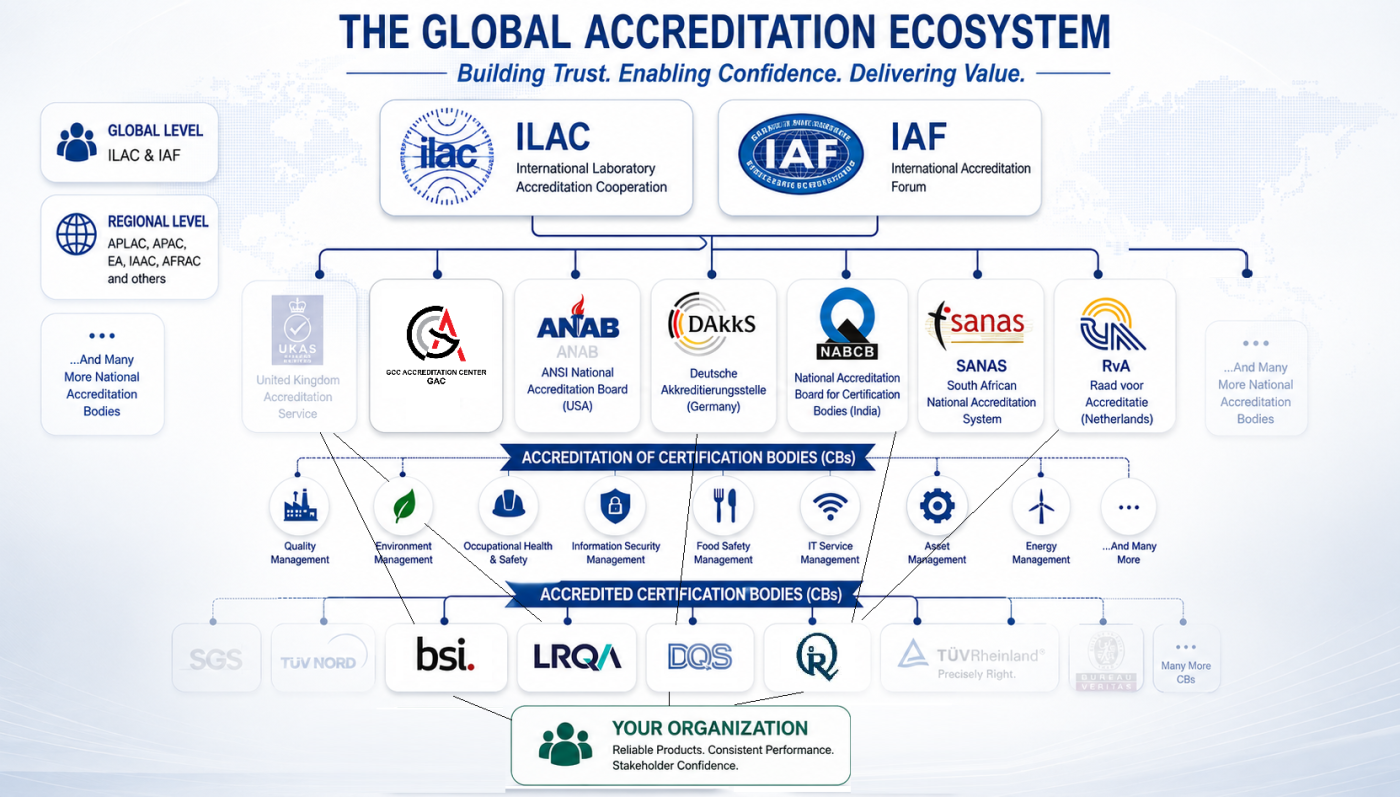
The answer is surprisingly straightforward. Follow the chain of confidence. So, when you see an ISO 9001:2015 Certificate, please verify its credibility.
Every certificate should clearly identify the Certification Body (CB) that issued it.
The first question should be: "Who issued this certificate?"
A credible Certification Body should be accredited by a recognized Accreditation Body (AB).
The certificate should normally display:
The next question, therefore, becomes: “Is this Certification Body accredited?"
If the answer is "No," further investigation is necessary because the certificate may not have undergone independent oversight.
This is where many organizations stop asking questions. But this is perhaps the most important question of all. "Who recognizes the Accreditation Body itself?"
Examples of a few recognized Accreditation Bodies include:
The Accreditation Body itself should be nationally recognized and subject to international peer evaluation. This list is for your information and is not a complete list of all accreditation bodies in the world. I am not trying to promote any of these ABs-it’s purely for sharing knowledge
For Management System Certification under ISO/IEC 17021-1, the Accreditation Body should be a recognized member and signatory within the International Accreditation Forum (IAF) framework.
For Laboratory Accreditation under ISO/IEC 17025, the Accreditation Body should be recognized within the International Laboratory Accreditation Cooperation (ILAC) framework.
Therefore ask:
"Is the Accreditation Body recognized within the IAF framework for management systems certification?"
or
"Is the Accreditation Body recognized within the ILAC framework for laboratory accreditation?"
If the answer is unclear, verification should be performed directly through official IAF or ILAC resources.
A credible certificate follows a clear chain:
Organization ↓ Certification Body (CB) ↓ Accreditation Body (AB) ↓ IAF / ILAC International Recognition
The confidence of each level depends upon the confidence of the level above it.
This is why accreditation is often described as a "Chain of Trust."
For a certificate operating within a credible ecosystem, you will typically see:
✓ Your Organization Name
✓ Your Certification Body Logo
✓ Accreditation Body Logo of your Certification Body
✓ Accreditation Number or Reference
And often the Accreditation Body itself will be traceable through the internationally recognized IAF or ILAC framework.
In simple terms, A credible certificate should be traceable from the certified organization all the way to an internationally recognized accreditation framework.
Whenever you receive a certificate, ask only three questions:
If you can follow the chain from: Organization → Certification Body → Accreditation Body → IAF/ILAC Recognition
You are likely operating within a credible accreditation ecosystem. If the chain breaks at any point, additional due diligence becomes essential.
A certificate should never be accepted simply because it looks impressive. Beautiful logos, sophisticated websites, and attractive certificates do not create confidence.
Confidence comes from an unbroken chain of competence, impartiality, oversight, and international recognition.
In the world of conformity assessment, trust is not printed on a certificate.
Trust is verified by the accreditation ecosystem that stands behind it.
We are looking for professional organizations for joining in our extended global network in your home country. Organizations which is a legal entity meeting our criteria are the ideal ones to join our network. We will honor mutual agreements for training services and want the services be undertaken with utmost professional integrity and due diligence to create value for our customers

M S Ray
Managing Director and Founder of TCB Cert. Worldwide Group
0 comment