
M S Ray
 0 comment
 23 Jun, 2026
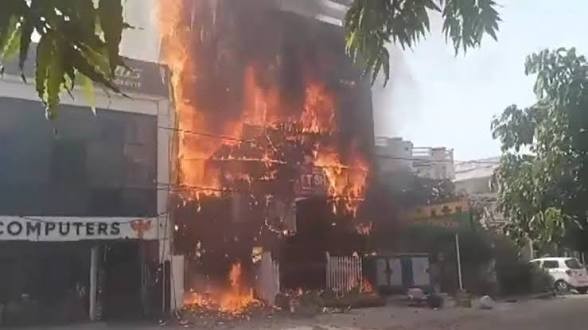
Recent years have witnessed heartbreaking fire tragedies across India and the world. Hospitals, hotels, restaurants, shopping complexes, factories, residential buildings, and public facilities have all experienced devastating incidents resulting in the loss of innocent lives.
Whether it was the AMRI Hospital Fire in Kolkata, hospital fires in Delhi and Uttar Pradesh, commercial building fires in Mumbai, or the tragic residential building fire in Kuwait that claimed many lives, a common question always emerges afterward:
Could these deaths have been prevented?
In many cases, the answer is unfortunately Yes.
Most catastrophic fires do not occur because of one single failure. They happen when multiple safety barriers fail simultaneously:
This is exactly why ISO 45001:2018 places enormous emphasis on:
The standard recognizes a simple truth:
People should go home safely after work.
An Occupational Health & Safety (OH&S) Audit is not a paperwork exercise.
At its core, it is a systematic process of identifying weaknesses before they become tragedies.
A competent safety audit asks difficult but essential questions:
The purpose of an audit is simple:
To discover weaknesses before an accident discovers them for us.
However, the importance of an OH&S audit extends far beyond compliance with ISO 45001 or local regulations.
Every life lost in a preventable accident represents a failure somewhere in the system.
Many catastrophic incidents are not caused by a lack of standards, procedures, or regulations. They occur because hazards were not identified, risks were underestimated, controls were not maintained, or warning signs were ignored.
An effective audit helps organizations identify and correct these failures before innocent people pay the price.
One properly conducted OH&S audit can save dozens or even hundreds of lives.
Every employer, hotel owner, hospital administrator, shopping mall operator, school management team, and public facility operator has a fundamental Duty of Care.
People entering a facility trust that reasonable precautions have been taken to protect them.
Guests staying in a hotel, patients receiving treatment in a hospital, families visiting a shopping mall, and employees reporting to work should never be exposed to unacceptable risks because basic safety controls were overlooked.
An audit verifies whether the organization is genuinely fulfilling this responsibility.
Following a major fire or accident, investigations often reveal:
These failures frequently result in criminal investigations, regulatory penalties, civil lawsuits, business closures, and imprisonment of responsible individuals.
A robust OH&S audit provides assurance that legal and regulatory obligations are being implemented and monitored effectively.
A major fire can destroy more than property.
It can stop operations overnight.
Organizations may experience:
This is where Occupational Health & Safety and Business Continuity Management become closely linked.
The safest organizations are often the most resilient organizations.
OH&S audits help identify catastrophic risks that could threaten the organization's ability to continue operating and serving customers.
Protecting people and protecting business continuity are inseparable objectives.
Trust takes years to build and minutes to destroy.
Following a serious accident, the organization's name may become permanently associated with tragedy.
Customers, patients, guests, regulators, investors, and business partners may lose confidence.
The reputational damage can far exceed the direct financial loss.
A strong safety culture demonstrated through regular audits sends a clear message:
"This organization takes the safety of people seriously."
Major accidents do not only affect individual organizations.
They can damage the image of an entire city or country.
When a hotel fire, hospital fire, shopping mall disaster, industrial accident, or residential building tragedy receives international media attention, the world begins asking questions:
For countries dependent on tourism, hospitality, healthcare services, international business, and foreign investment, public confidence is critical.
Every preventable tragedy damages national credibility.
Every well-managed facility enhances it.
In this sense, safety is not merely an organizational responsibility—it is a contribution to national reputation and public confidence.
True leadership is measured not only by profits and growth but by how well leaders protect people.
The best organizations understand that safety is not a cost.
It is an investment in people, resilience, trust, and long-term sustainability.
A mature OH&S audit program demonstrates leadership commitment to protecting employees, customers, visitors, patients, contractors, and the wider community.
One of the leading causes of fires worldwide.
Common causes include:
✓ Thermographic inspection of panels
✓ Routine electrical preventive maintenance
✓ Load balancing
✓ Proper earthing and bonding
✓ Residual Current Devices (RCD)
✓ Electrical inspection by competent personnel
✓ Immediate repair of damaged wiring
Critical for:
Common ignition sources:
✓ LPG leak detection systems
✓ Automatic gas shut-off valves
✓ Regular inspection of hoses and regulators
✓ Grease duct cleaning schedule
✓ Fire blankets
✓ Kitchen suppression systems
✓ Staff emergency response training
Examples:
✓ Approved storage areas
✓ Segregation from ignition sources
✓ Proper ventilation
✓ Quantity limitations
✓ Safety Data Sheets available
✓ Fire-rated cabinets where necessary
Hospitals are particularly vulnerable because occupants often cannot self-evacuate.
Critical risks include:
✓ Compartmentalization
✓ Fire doors
✓ Evacuation plans by ward
✓ Staff emergency drills
✓ Backup power systems
✓ Patient evacuation equipment
Risks include:
✓ Crowd management
✓ Emergency lighting
✓ Clearly marked exits
✓ Public address systems
✓ Trained emergency wardens
✓ Routine evacuation drills
Many fire investigations reveal a shocking reality:
People survived the fire but died because they could not escape.
Emergency exits must:
✓ Be clearly marked
✓ Remain unlocked during occupancy
✓ Be illuminated
✓ Be inspected regularly
✓ Open outward
✓ Remain completely free from obstruction
✓ Lead to a safe assembly point
Every occupied area should ideally have at least two independent escape routes.
If one route becomes blocked by smoke or fire, occupants must have an alternative means of escape.
Many organizations have emergency procedures sitting in binders.
Unfortunately, emergencies do not read procedures.
Emergency preparedness becomes effective only when it is practiced.
ISO 45001 Clause 8.2 requires organizations to:
Every drill should answer:
A drill that identifies weaknesses is successful.
A drill that reveals nothing may indicate it was not realistic.
Fire safety is not only for workplaces.
Many homes contain significant fire hazards.
✓ Check for gas leaks
✓ Replace damaged hoses
✓ Keep cylinders upright
✓ Turn off valves when not in use
✓ Never store cylinders near heat sources
✓ Avoid overloading sockets
✓ Replace damaged cables
✓ Use quality electrical equipment
✓ Inspect old wiring periodically
✓ Avoid multiple adapters
✓ Install smoke alarms
✓ Keep fire extinguishers
✓ Know emergency numbers
✓ Establish a family evacuation plan
✓ Ensure exits are not blocked
✓ Practice evacuation periodically
□ Inspect all emergency exits
□ Remove all obstructions
□ Verify emergency lighting
□ Verify fire alarm functionality
□ Check extinguisher validity
□ Inspect LPG systems
□ Inspect electrical panels
□ Review emergency contact lists
□ Conduct formal fire risk assessment
□ Update emergency response procedures
□ Conduct evacuation drill
□ Train all employees
□ Verify contractor safety controls
□ Inspect all fire protection systems
□ Review hazardous material storage
□ Complete comprehensive OH&S audit
□ Review high-risk operations
□ Conduct scenario-based emergency exercises
□ Evaluate leadership response capability
□ Implement corrective actions
□ Review lessons learned
Every major fire disaster teaches the same painful lesson:
The cost of prevention is insignificant compared to the cost of losing human lives.
Fire safety is not merely a legal requirement.
It is not merely an ISO 45001 requirement.
It is a moral responsibility.
Every blocked exit, every ignored electrical defect, every untested emergency plan, and every missed audit finding may represent a future tragedy waiting to happen.
The next catastrophic incident may be prevented by one inspection, one audit, one corrective action, one emergency drill, or one employee who was properly trained.
The question is not whether we can afford to invest in safety.
The question is whether we can afford not to.
We are looking for professional organizations for joining in our extended global network in your home country. Organizations which is a legal entity meeting our criteria are the ideal ones to join our network. We will honor mutual agreements for training services and want the services be undertaken with utmost professional integrity and due diligence to create value for our customers

M S Ray
Managing Director and Founder of TCB Cert. Worldwide Group
0 comment