
M S Ray
 0 comment
 15 Jul, 2026
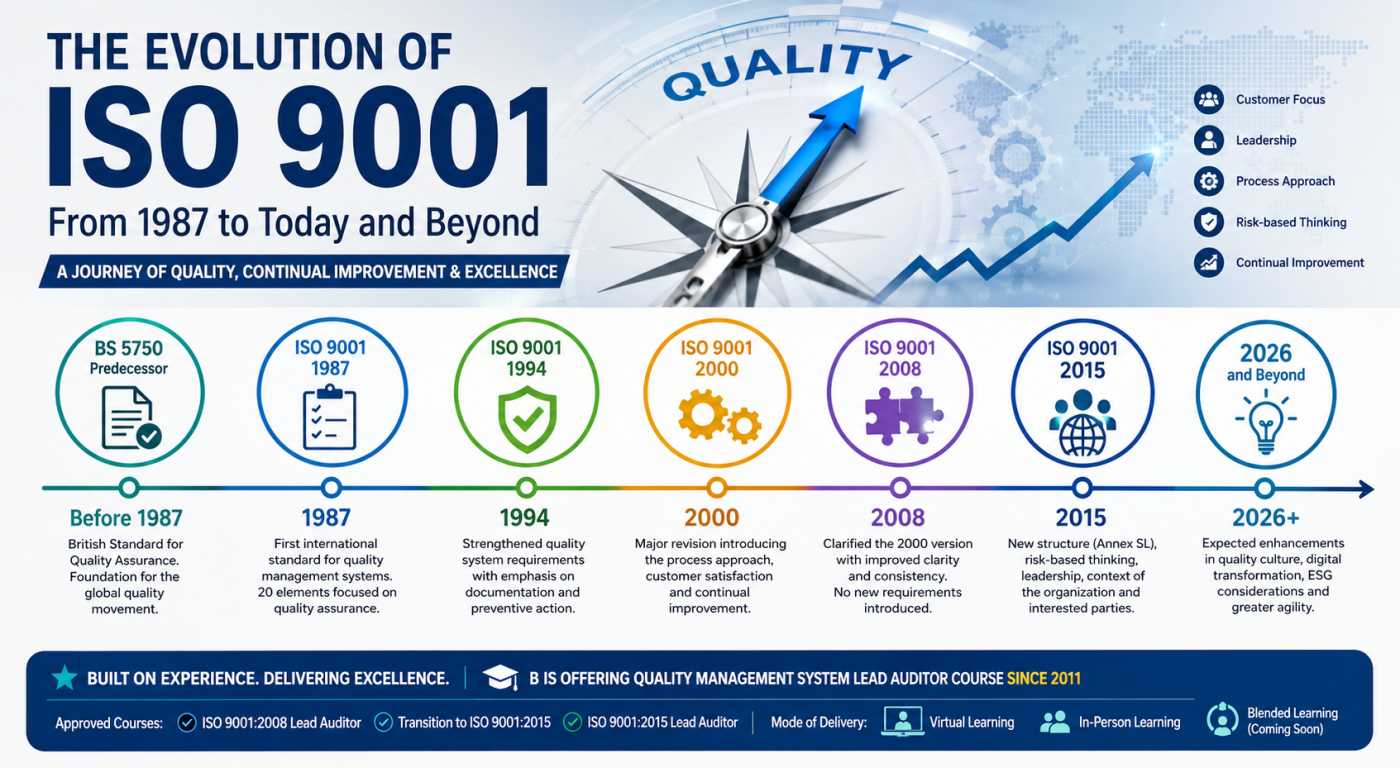
How the world’s leading Quality Management System standard evolved from inspection-based assurance to strategic, risk-based and culture-driven management
Meta description: Explore the evolution of ISO 9001 from its predecessor, BS 5750, through the 1987, 1994, 2000, 2008 and 2015 editions, the 2024 climate amendment, and the expected ISO 9001:2026 revision.
Few management standards have influenced global business as profoundly as ISO 9001.
Since its first publication in 1987, ISO 9001 has moved far beyond its early role as a contractual quality-assurance model. It has gradually developed into a comprehensive framework for managing processes, satisfying customers, addressing risks, strengthening leadership and continually improving organizational performance.
Its history also reflects the evolution of the quality profession itself:
Inspection → Quality Control → Quality Assurance → Quality Management → Business Integration → Risk-Based and Culture-Driven Quality
ISO confirms that the first ISO 9001 edition was published in 1987 and subsequently revised in 1994, 2000, 2008 and 2015. A sixth edition is now in the final publication stage and is expected in September 2026.
Understanding this evolution is important for quality managers, auditors, consultants, trainers and organizational leaders because every revision represents a change in how the world understands and manages quality.
The story of ISO 9001 did not begin in Geneva. Its most important predecessor was the British Standard BS 5750 — Quality Systems, first published in 1979.
BS 5750 provided organizations with a structured model for demonstrating that they had adequate systems to control the quality of their products and operations. BSI confirms that ISO 9001 was based substantially on the BS 5750 series.
The need for such a standard had been developing for many years.
Large government, defence, aerospace, engineering and manufacturing customers often imposed their own quality-assurance requirements on suppliers. A supplier working for several major customers could therefore face different specifications, different assessment methods and repeated customer audits.
As manufacturing and international trade expanded, organizations needed a commonly accepted method of answering an increasingly important question:
Can this supplier consistently provide a product that meets specified requirements?
There was no single event that created ISO 9001. It emerged from the accumulated need for:
BSI and other national standards bodies consequently promoted the development of an international quality-management and quality-assurance standard through ISO Technical Committee 176. ISO specialists involved in the early work have confirmed that BS 5750 was one of the principal source documents used in developing the ISO 9000 family.
The first edition was formally titled:
ISO 9001:1987 — Quality Systems: Model for Quality Assurance in Design/Development, Production, Installation and Servicing
It was primarily designed for contractual situations in which a customer needed confidence in a supplier’s ability to design and provide conforming products.
The 1987 ISO 9000 family offered three alternative certification models:
These were not three maturity levels. They represented different scopes of organizational activity.
The standard contained introductory clauses on scope, references and definitions, followed by Clause 4, which included 20 quality-system elements:
The structure reflected the manufacturing and supplier-assurance environment of the period. Terms such as “supplier,” “purchaser,” “product,” “inspection” and “test status” were prominent.
Before this model, many organizations depended heavily on inspecting products after production. ISO 9001:1987 encouraged organizations to establish controls throughout the product-realization cycle.
Quality was no longer only the responsibility of the final inspector. It had to be supported by:
The greatest contribution of ISO 9001:1987 was confidence through a documented system.
A customer could assess not merely a batch of finished products, but the supplier’s ability to control the activities that created those products. This helped establish a common international foundation for supplier qualification, contractual assurance and third-party certification.
However, the standard was frequently implemented as a collection of separate procedures. Many systems became document-heavy and departmental, with limited attention to process interaction, customer satisfaction or business performance.
The second edition retained the title and basic philosophy of the original quality-assurance model:
ISO 9001:1994 — Quality Systems: Model for Quality Assurance in Design, Development, Production, Installation and Servicing
ISO 9001, ISO 9002 and ISO 9003 continued as separate conformity-assessment models.
The familiar 20-element structure remained:
Although the structure remained broadly unchanged, the 1994 edition strengthened several areas.
The former “corrective action” element became corrective and preventive action.
Corrective action addressed the causes of existing nonconformities. Preventive action required organizations to identify and eliminate causes of potential nonconformities before failure occurred.
“Document control” became document and data control, reflecting the increasing importance of electronic information and controlled technical data.
The edition placed stronger emphasis on:
Handling and storage controls were expanded to include the preservation of products while under the organization’s control.
The 1994 revision moved quality assurance further toward prevention rather than dependence on detection.
Organizations were expected to demonstrate that their systems could prevent mistakes through planning, documented controls and preventive action.
However, it remained highly procedural. Many organizations responded by creating a quality manual and a separate procedure for almost every element. The system often became something the quality department maintained for certification rather than an integrated method of managing the business.
That limitation created the need for a much more fundamental revision.
ISO 9001:2000 represented the most significant transformation in the standard’s history up to that point.
Its title changed from a “model for quality assurance” to:
ISO 9001:2000 — Quality Management Systems: Requirements
This was not merely a change of wording. It represented a change in philosophy.
The focus moved from proving that 20 separate elements had been documented to understanding and managing a connected system of processes.
The 20-element model was replaced by an eight-clause structure:
Clauses 4 to 8 contained the certifiable requirements.
ISO 9001, ISO 9002 and ISO 9003 were consolidated into one generic requirements standard.
An organization could identify justified non-applicable requirements within product-realization activities, provided those exclusions did not affect its ability or responsibility to supply conforming products.
Organizations were required to identify their processes, understand their sequence and interaction, establish controls and evaluate whether the processes achieved intended results.
Instead of asking only, “Do we have the required procedure?”, auditors increasingly had to ask:
The standard moved beyond product conformity and required organizations to monitor information relating to customer perception.
Organizations were required to continually improve the effectiveness of the QMS through objectives, audits, data analysis, corrective action, preventive action and management review.
The structure supported the application of PDCA:
The more generic language and process orientation made ISO 9001 considerably more practical for service organizations, educational institutions, healthcare providers, public bodies, hospitality businesses and professional services.
ISO 9001:2000 transformed the standard from a documented quality-assurance system into a process-based management system.
It asked organizations to manage the flow of work across departmental boundaries and connect quality objectives with customer satisfaction and continual improvement.
This edition laid the foundation for the modern understanding of ISO 9001.
ISO 9001:2008 retained the same eight-clause structure and fundamental requirements introduced in 2000.
ISO’s official implementation guidance made an important point: the 2008 edition introduced no additional requirements and did not change the intent of ISO 9001:2000. Its purposes were to clarify existing requirements and improve compatibility with ISO 14001:2004.
The revision provided greater clarity concerning matters such as:
ISO 9001:2008 improved consistency of interpretation without forcing organizations to redesign effective systems.
It demonstrated that not every revision must introduce major new requirements. Sometimes the most valuable improvement is clearer language, better compatibility and reduced misunderstanding.
For auditors, the 2008 edition reinforced a vital lesson: auditing is not simply comparing words in a procedure with words in a clause. It requires understanding the intent of the requirement and evaluating whether organizational processes are effective.
The 2015 edition was the first major revision since 2000.
ISO explained that the revision responded to substantial changes in technology, business diversity, global commerce, complex supply chains, customer expectations and the growing importance of service organizations.
The standard adopted ISO’s High-Level Structure—now referred to more generally as the Harmonized Structure—for management-system standards:
This common structure made it easier to integrate ISO 9001 with standards such as ISO 14001, ISO 45001, ISO 27001, ISO 22301 and ISO 50001.
Organizations were required to understand the internal and external issues that could affect the intended results of the QMS.
This connected quality management to market conditions, technology, regulation, organizational culture, capability, competition and strategic direction.
Organizations had to determine the relevant interested parties and their relevant requirements.
Customer requirements remained central, but organizations also had to consider other parties whose needs could affect the QMS.
Quality could no longer be delegated entirely to a management representative.
Top management became directly accountable for integrating the QMS into business processes, aligning it with strategic direction, supporting the process approach and promoting continual improvement.
The separate preventive-action clause disappeared.
Prevention was embedded across the system through risk-based thinking. Organizations were expected to determine risks and opportunities and plan proportionate actions.
The intention was not necessarily to impose a formal enterprise risk-management system, but to ensure that uncertainty and potential failure were considered while planning and controlling processes.
The standard formally recognized knowledge as a resource that must be determined, maintained and made available.
This became increasingly important as organizations faced employee turnover, technological change, outsourcing and the loss of experience held by key individuals.
The language was broadened to recognize that ISO 9001 applies equally to service organizations.
The former purchasing requirements were expanded into a broader control framework covering suppliers, contractors, outsourced processes and other external providers.
The former distinction between “documents” and “records” was replaced by the broader term documented information.
A quality manual and six specifically mandated documented procedures were no longer compulsory. However, this did not mean documentation was unnecessary. Organizations still had to maintain and retain sufficient information to support process operation and provide evidence of conformity.
The standard became less prescriptive about exactly how an organization should operate and more concerned with whether the organization’s processes achieved their intended results.
ISO described the 2015 edition as more performance-based, focusing more strongly on what must be achieved than on prescribing how it must be achieved.
ISO 9001:2015 repositioned the QMS as a strategic management system rather than a certification department’s documentation system.
It enabled organizations to design a QMS appropriate to their:
For auditors, it also demanded a higher level of professional judgement. Auditors needed to understand organizational context, processes, risks, leadership decisions and performance—not merely search for prescribed procedures.
In February 2024, ISO published:
ISO 9001:2015/Amd 1:2024 — Climate Action Changes
This was an amendment to the 2015 edition, not a completely new edition.
The amendment added an explicit requirement for organizations to determine whether climate change is a relevant issue within their organizational context. It also added a note recognizing that relevant interested parties can have climate-change-related requirements.
The amendment does not mean that every ISO 9001-certified organization must establish an environmental management programme or calculate its carbon footprint.
It means that the organization must seriously consider whether climate change could affect matters such as:
Where climate change is relevant, the QMS should address it. Where it is not relevant, the organization should be able to demonstrate that it reached that conclusion through a credible evaluation.
As of July 2026, the sixth edition of ISO 9001 has reached the final publication stage.
ISO identifies the forthcoming document as Edition 6, expected to replace ISO 9001:2015 in September 2026. The Final Draft International Standard was balloted during 2026 and the project is now shown as being in final production.
The final published standard will remain the authoritative source. However, information released on the Final Draft indicates that the 2026 revision will be an evolution rather than a complete restructuring.
The familiar ten-clause Harmonized Structure is expected to remain.
The revised standard is expected to place clearer emphasis on establishing and promoting a culture in which quality is understood, valued and practised throughout the organization.
Quality culture cannot be created by displaying a policy on a wall. It is demonstrated when people:
Leadership and awareness requirements are expected to make ethical behaviour more explicit.
This recognizes that sustainable quality depends not only on technical controls but also on honesty, integrity, transparency and responsible decision-making.
An organization cannot claim to possess a mature quality culture while concealing defects, manipulating data, misleading customers or pressuring employees to approve nonconforming work.
The 2015 edition discusses risks and opportunities together. The 2026 revision is expected to distinguish them more clearly.
Risks concern uncertainty that may prevent intended results. Opportunities concern circumstances that may improve performance, customer satisfaction, innovation, resilience or organizational capability.
The separation should help organizations move beyond defensive risk registers and give greater attention to opportunity-based thinking.
The new edition is expected to strengthen requirements concerning planned organizational change.
This is particularly relevant where organizations introduce:
The objective is to ensure that change is planned, resourced, communicated and controlled rather than allowed to unintentionally weaken the QMS.
The revised wording is expected to better recognize the reality of digital management systems.
Evidence of conformity may now exist within:
The focus is expected to remain on the availability, reliability, integrity and usefulness of evidence rather than on whether a traditional paper record exists.
The climate considerations introduced through the 2024 amendment are expected to be incorporated into the new edition.
Organizations will still need to determine relevance within the context of their QMS rather than treating ISO 9001 as an environmental certification standard.
Organizations increasingly receive customer feedback through websites, applications, social media, online marketplaces, digital reviews and real-time service channels.
The revision is expected to provide greater recognition of these modern sources of customer perception and performance information.
The forthcoming edition is expected to contain an expanded informative Annex A explaining the structure, terminology and intended interpretation of important requirements.
This could help organizations and auditors reduce inconsistent interpretations and understand the relationship between the clauses more clearly.
BSI’s guidance on the Final Draft highlights quality culture, ethical behaviour, climate change, clearer separation of risks and opportunities, change management, digital evidence and expanded Annex A guidance as important features of the forthcoming edition.
The 2026 revision is expected to make ISO 9001 more relevant to organizations operating in an environment shaped by:
The revision appears intended to strengthen the human and cultural dimensions of quality without abandoning the process approach, risk-based thinking or the existing ten-clause structure.
| Edition | Main Structure | Dominant Philosophy |
| BS 5750:1979 | National quality-system models | Supplier assurance |
| ISO 9001:1987 | 20 quality-system elements | Documented quality assurance |
| ISO 9001:1994 | 20 strengthened elements | Prevention and documented control |
| ISO 9001:2000 | Eight-clause process structure | Process management, customers and continual improvement |
| ISO 9001:2008 | Same eight-clause structure | Clarification and compatibility |
| ISO 9001:2015 | Ten-clause Harmonized Structure | Context, leadership, risk and strategic integration |
| 2024 Amendment | Changes within Clauses 4.1 and 4.2 | Consideration of climate change |
| ISO 9001:2026 | Ten-clause structure expected to continue | Quality culture, ethics, change, opportunity and digital evidence |
The history of ISO 9001 demonstrates that quality management has never remained static.
The standard has progressively moved:
A competent auditor must therefore understand more than the latest clause numbers.
The auditor should understand why the requirements exist, how the concepts have evolved and how to evaluate whether a management system is producing credible results.
That historical understanding distinguishes a checklist auditor from a professional management-system auditor.
Since 2011, TCB — Training & Certification Bureau has been developing Quality Management System auditors and quality professionals through its approved auditor-training programmes.
TCB’s QMS training journey has followed the evolution of the standard through:
The programme is delivered through:
A blended-learning model combining structured self-study with tutor-guided sessions is also under development.
The TCB Lead Auditor Course is designed not merely to help participants memorize ISO 9001 clauses. It develops the ability to:
As ISO 9001 prepares to enter its sixth edition, quality professionals will once again need to develop new knowledge, update their audit practices and understand the intent behind the changes.
The standard continues to evolve.
The question for every quality professional is: Are we evolving with it?
We are looking for professional organizations for joining in our extended global network in your home country. Organizations which is a legal entity meeting our criteria are the ideal ones to join our network. We will honor mutual agreements for training services and want the services be undertaken with utmost professional integrity and due diligence to create value for our customers

M S Ray
Managing Director and Founder of TCB Cert. Worldwide Group
0 comment