M S Ray
 0 comment
 18 Oct, 2026
17 October 2026 | Kolkata, West Bengal
Durga Puja is more than a religious festival in Bengal. It is a celebration of faith, culture, creativity, community, and human togetherness. Millions of people visit beautifully decorated pandals with their families, children, and loved ones to celebrate the triumph of good over evil.
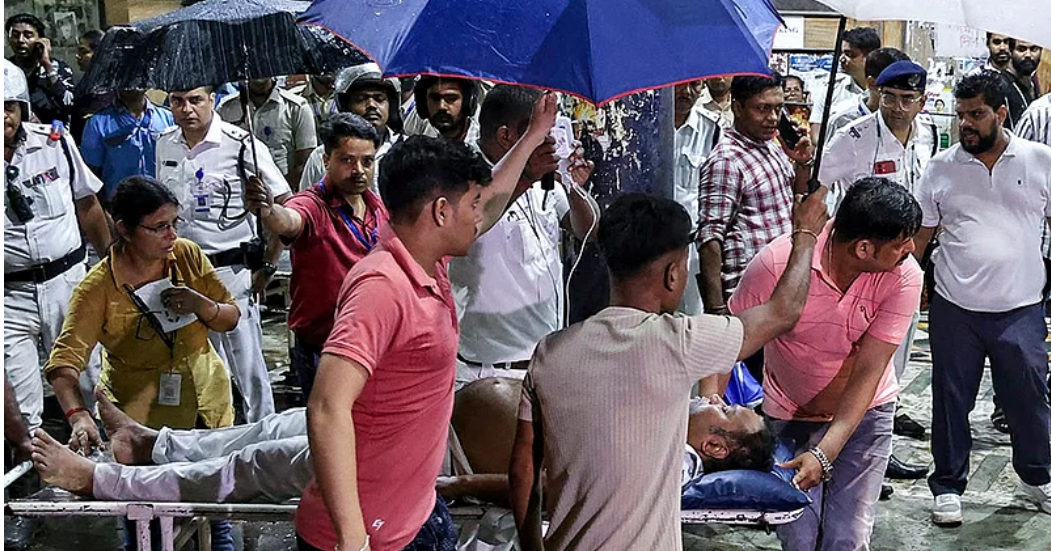
Yet, on the evening of 17 October 2026, celebrations at the Chorbagan Sarbojanin Durga Puja pandal in North Kolkata were overshadowed by a heartbreaking tragedy.
Early media reports indicate that at least 17 people may have lost their lives, with several others injured following a sudden crowd surge during heavy rainfall. The final casualty figures and circumstances remain subject to official confirmation.
Our deepest condolences go to the bereaved families, and our heartfelt prayers are with those injured. We wish them a speedy and complete recovery.
But beyond our grief, there is a question that deserves serious reflection:
Could this tragedy have been prevented? And, more importantly, what must we learn to ensure that such incidents never happen again?
The immediate public reaction to such tragedies is often predictable. Who is responsible? Was it the organizers? Was it the administration? Was it the police? Or was it the behaviour of the visitors themselves?
These are legitimate questions. Accountability is necessary, particularly where negligence or violations of safety requirements are established.
However, as a management systems and occupational health and safety professional, I believe we must look beyond the blame game.
Finding someone to blame may satisfy public anger. Identifying and eliminating the root causes can prevent the next tragedy and save lives.
According to preliminary reports, sudden rainfall contributed to the crowd surge at the pandal. People waiting outside reportedly rushed forward to seek shelter, creating intense pressure in an already congested area.
The exact sequence of events must be established through an independent investigation.
However, from a risk management perspective, the incident raises several fundamental questions.
Was the maximum safe occupancy of the pandal established? Was there adequate space to accommodate visitors during unexpected weather conditions? Were entrance and exit routes designed to prevent opposing crowd movements? Were arrangements in place to stop additional entry when crowd density reached unsafe levels?
Were emergency evacuation routes available, clearly identified, and kept unobstructed?
Reports and concerns about possible restrictions caused by temporary stalls or other installations should also be examined. Any obstruction of a designated emergency exit would represent a serious safety concern, although whether this occurred at Chorbagan must be established by investigators.
Most importantly, had the organizers anticipated the possibility of heavy rainfall, sudden crowd movement, or panic-like conditions?
Kolkata's weather is not entirely predictable, but the possibility of rain during a major outdoor celebration is hardly unimaginable.
Rainfall may have been the triggering event. But was it the root cause?
In accident investigation, we distinguish between an immediate trigger, contributing factors, and underlying systemic failures.
A sudden downpour may trigger crowd movement. However, whether that movement becomes a catastrophe depends significantly on the adequacy of the crowd management system.
A well-designed safety system should anticipate foreseeable emergencies and prevent them from escalating into disasters.
There is another disturbing question that deserves attention. What if, instead of rainfall, the emergency had been a fire?
Durga Puja pandals are often temporary structures involving decorative materials, fabrics, electrical installations, lighting arrangements, and other potentially combustible components.
Temporary electrical connections, overloaded circuits, damaged cables, inadequate protection, and loose electrical terminations can become ignition sources.
In a densely occupied pandal, a fire could develop rapidly, depending on the materials used and the available fire protection.
Now imagine thousands of visitors attempting to escape simultaneously through restricted or inadequate exits.
The consequences could be catastrophic.
This is why risk assessment cannot be limited to what has happened previously. It must also consider what could reasonably happen, how severe the consequences might be, and whether existing controls are sufficient.
A low-frequency event with potentially catastrophic consequences cannot simply be dismissed as unlikely.
Fire prevention, emergency preparedness, safe electrical installations, appropriate fire extinguishers, trained volunteers, and unobstructed emergency exits must be fundamental conditions for allowing large public gatherings.
Safety should never depend on good fortune.
On 24 July 2010, the Love Parade music festival in Duisburg, Germany, ended in tragedy.
Twenty-one people lost their lives, and more than 650 were injured when severe crowd congestion developed around an access ramp and associated routes.
Subsequent investigations and technical studies identified major weaknesses in event planning, crowd-flow arrangements, coordination, and the suitability of the venue for the expected movement of people.
Germany is a highly developed country with sophisticated infrastructure and regulatory systems. Yet the tragedy occurred.
The lesson is profound.
Economic development, technological advancement, and administrative sophistication do not automatically guarantee safety. Safety must be consciously designed, implemented, monitored, and continuously improved.
The Duisburg disaster demonstrated that crowd movement must be assessed as an interconnected system.
The capacity of a venue alone is not enough. Entry routes, exit routes, connecting roads, waiting areas, barriers, and emergency access must all be considered together.
A crowd can become dangerously compressed even when the overall number of visitors appears manageable.
Research into the disaster also challenges the simplistic assumption that such incidents are caused primarily by people panicking. In extremely dense crowds, individuals may lose the physical ability to control their movements.
The fundamental danger is often excessive crowd pressure rather than irrational behaviour.
This distinction matters because it shifts the focus from blaming victims to designing safer environments.
Another painful reminder comes from the Hajj pilgrimage.
On 24 September 2015, a devastating crowd crush occurred at Mina, near the holy city of Makkah.
Saudi authorities reported 769 deaths. The tragedy demonstrated the extraordinary challenges involved in managing large numbers of people moving through shared routes within limited periods.
The broader lesson is not about religion or the behaviour of pilgrims.
It is about the importance of scientifically planned crowd movement, controlled access, effective communication, emergency preparedness, and coordination among multiple responsible agencies.
Whether people gather for Durga Puja in Kolkata, Hajj in Makkah, or a music festival in Germany, the underlying principles of crowd safety remain remarkably similar.
Human life has the same value everywhere, and the principles of prevention must be universal.
The above incidents and many other such incidents strengthen my central view that catastrophic crowd incidents are not confined to any particular country, religion, festival, or culture. They are a global public-safety challenge requiring systematic risk management.
The Chorbagan incident deserves a systematic, evidence-based investigation rather than conclusions driven by emotion, speculation, or political considerations.
The investigation should examine not merely what happened in the final moments but also the decisions, conditions, and management arrangements that existed before the incident.
First, there is the responsibility of the organizers.
Large public events cannot be managed solely on enthusiasm, goodwill, and the dedication of volunteers.
Organizers must understand the hazards associated with their events, evaluate risks, establish safe occupancy limits, maintain clear entrances and exits, provide sufficient trained personnel, and develop credible emergency response arrangements.
A pandal that attracts thousands of visitors is not merely a temporary decorative structure. It is a temporary public assembly facility with significant safety responsibilities.
Second, there is the role of the administration and regulatory authorities.
Were clear safety requirements established? Were crowd management plans reviewed? Were fire and electrical safety arrangements inspected? Were occupancy limits specified and enforced? Were emergency access routes checked before permission was granted?
India already has various fire safety, disaster management, police, and local permission mechanisms. The question is whether the applicable requirements are sufficiently integrated, consistently implemented, and effectively enforced.
Introducing new regulations alone will not solve the problem if existing requirements are not properly implemented.
A regulation that exists only on paper cannot protect a single life.
Third, we must examine operational monitoring.
Crowd density changes throughout the evening. A safe arrangement at 5 p.m. may become dangerously congested by 8 p.m.
Were trained personnel monitoring visitor movement? Could they identify early warning signs? Did they have authority to stop entry immediately? Were police, organizers, and volunteers communicating effectively?
Effective crowd management requires decisions before conditions become critical.
Finally, the investigation should consider emergency preparedness and medical response.
Were emergency routes accessible? Were first-aid facilities and trained responders available? Could ambulances reach the location? Were nearby hospitals informed and prepared to receive casualties?
The adequacy of these arrangements should be assessed objectively.
There is also an important lesson for visitors.
We must develop greater awareness of our own safety and that of others. Why do we sometimes continue entering visibly overcrowded spaces? Why do we ignore warning signs, push through congested passages, or assume that someone else has already ensured our safety?
As responsible citizens, we should recognize dangerous crowd conditions, respect instructions, avoid pushing, protect children and elderly people, and report hazards when we observe them.
However, we must also recognize an important distinction.
Visitors have a responsibility to exercise reasonable care, but organizers and authorities have a much greater responsibility because they control the design, capacity, permissions, and management of the event.
Once a crowd reaches dangerous density, individuals may no longer have the freedom to move or escape.
It would therefore be unjust to place the burden of preventing crowd disasters primarily on the victims.
Personal safety awareness is essential, but it can never replace an effective public safety management system.
With Durga Puja celebrations continuing across Kolkata and West Bengal, preventive action should not wait for the completion of a detailed investigation.
The administration and organizers should urgently review arrangements at heavily visited pandals, particularly those with restricted access, narrow approaches, or high visitor density. Let's Call it a Hazard Identification , Risk Assessment with determined controls which needs immediate implementation .
The immediate priorities should include controlled entry and exit, safe occupancy limits, unobstructed emergency routes, trained crowd management volunteers, adequate police coordination, accessible first-aid arrangements, and emergency medical readiness.
Temporary electrical installations must be inspected, combustible materials appropriately controlled, and suitable fire protection arrangements verified.
Where necessary, entry should be temporarily suspended, visitor numbers reduced, or access arrangements redesigned.
The principle must be simple:
If safe conditions cannot be maintained, the event must not continue operating at that level of occupancy.
No decoration, popularity, award, sponsorship, or commercial interest should ever take precedence over human life.
In management systems, we often speak about the PDCA cycle: Plan, Do, Check, Act.
The same principle applies to public safety.
We must plan events based on identified hazards and assessed risks. We must implement effective controls. We must monitor actual conditions and verify that arrangements remain adequate. And we must act immediately when weaknesses or dangerous conditions are identified.
This is also the underlying philosophy of ISO 45001, the international standard for occupational health and safety management systems.
Although ISO 45001 is primarily intended for managing occupational health and safety risks, its principles of hazard identification, risk assessment, operational control, emergency preparedness, incident investigation, and continual improvement provide valuable lessons for the management of public events.
The objective is not merely to demonstrate compliance.
It is to prevent harm.
A successful festival should not be measured only by the beauty of its decorations, the number of visitors, or the publicity it generates.
Its greatest achievement should be that every visitor returns home safely.
As we celebrate Durga Puja, I appeal to organizers, authorities, volunteers, and fellow citizens to make safety an inseparable part of our celebrations.
If you observe a blocked exit, unsafe electrical wiring, dangerous overcrowding, inadequate access, or any other serious hazard, please report it to the responsible authorities or organizers.
If a location appears dangerously congested, avoid entering it.
If an emergency develops, follow official instructions and help others where it is safe to do so.
And to those responsible for organizing and regulating public events, I make a sincere appeal: Do not wait for another tragedy before taking preventive action.
The purpose of an incident investigation should not end with identifying who made a mistake. It must establish why the system failed, what controls were missing or ineffective, and how similar failures can be prevented.
We cannot undo the suffering of the families affected by this tragedy. But we can honour those who have suffered by ensuring that their loss leads to meaningful improvements in public safety.
Let this heartbreaking incident become a turning point in the way we plan and manage large public gatherings. Let us remember that safety is not an inconvenience, a formality, or an additional cost. Safety is respect for human life.
May Goddess Durga bless the bereaved families with strength, grant a speedy recovery to the injured, and inspire all of us to become more responsible towards one another.
Wishing everyone a peaceful, happy and safe festive season.
— A reflection from an Occupational Health & Safety and Management Systems Professional
Madhusudan Ray
#DurgaPuja2026 #Kolkata #CrowdSafety #PublicSafety #RiskManagement #ISO45001 #RootCauseAnalysis #EmergencyPreparedness #SafetyCulture #IncidentPrevention
We are looking for professional organizations for joining in our extended global network in your home country. Organizations which is a legal entity meeting our criteria are the ideal ones to join our network. We will honor mutual agreements for training services and want the services be undertaken with utmost professional integrity and due diligence to create value for our customers

M S Ray
Managing Director and Founder of TCB Cert. Worldwide Group
0 comment