
M S Ray
 0 comment
 15 Aug, 2026
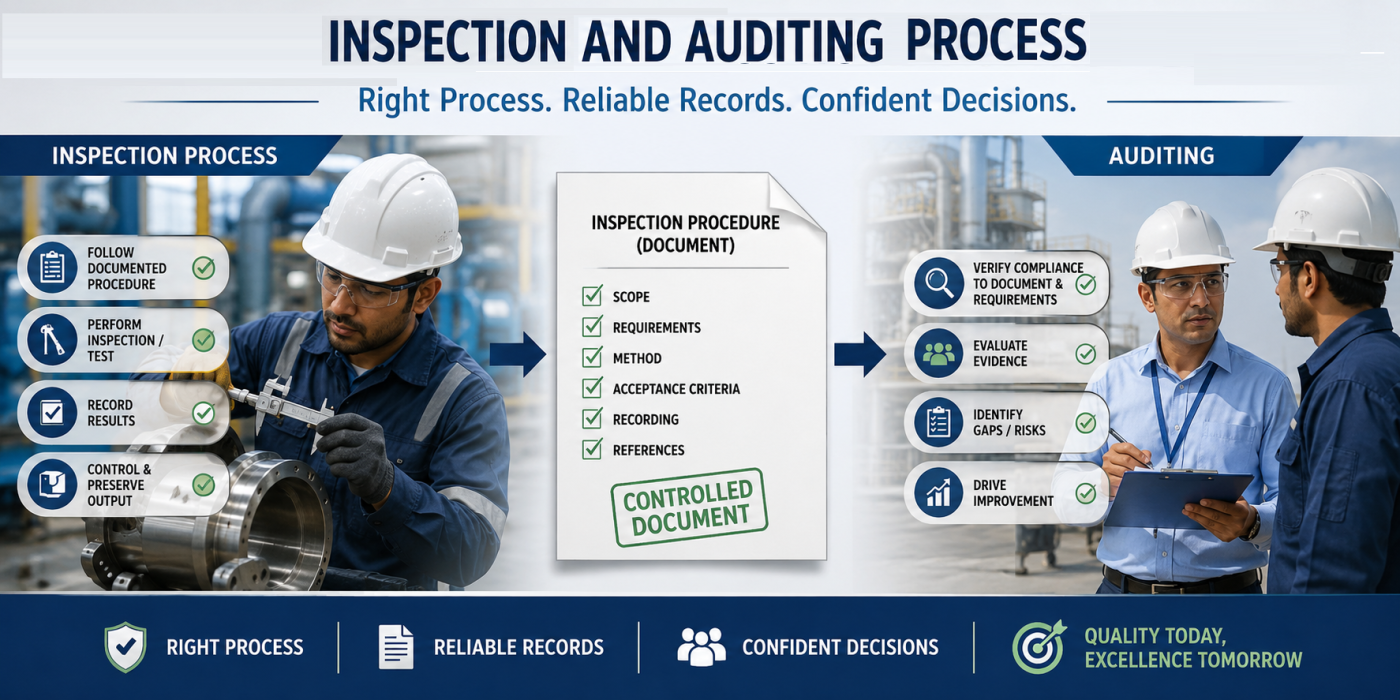
Why ISO 9001 Lead Auditor Competence Can Transform a Career in Quality, Manufacturing and Inspection
An engineering degree can get you through the door of industry.
But what makes an engineer valuable, dependable, and trusted is something more.
Industry needs professionals who can understand a requirement, translate it into a controlled process, recognize risk, verify conformity, interpret evidence, make technically sound decisions and protect the customer, the organization and themselves.
That is why engineers entering manufacturing, quality assurance, quality control, inspection, construction, oil and gas, fabrication, automotive, aerospace, power, infrastructure and industrial services should look beyond technical qualifications alone.
They should learn how an organization controls quality as a system.
And one of the strongest places to begin is ISO 9001.
As of August 2026, ISO 9001:2015 remains the current published edition of the Quality Management System standard. ISO/FDIS 9001 has reached the final stage of development and ISO expects the revised edition to replace ISO 9001:2015 in September 2026.
This makes the present period particularly valuable for young engineers: learn the established system deeply, understand the principles rather than merely memorizing clause numbers, and be prepared for the transition to the revised standard.
Start with the Foundation — Before Trying to Become an Auditor
My first career advice to an engineer is simple:
Do not rush directly toward the title "Lead Auditor." First understand the management system.
A good ISO 9001 Foundation course teaches the architecture and thinking behind a Quality Management System: the process approach, customer focus, leadership, risk-based thinking, competence, operational control, performance evaluation and continual improvement. CQI and IRCA themselves provide a defined QMS Foundation learning pathway before the professional auditing level.
The objective should not initially be:
"How do I pass an auditor examination?"
It should be:
"How does a professionally managed organization ensure that the right product or service is delivered correctly, consistently and reliably?"
Once you understand that, auditing begins to make sense.
And, more importantly, industry begins to make sense.
ISO 9001 Is Not Only for Auditors
This misunderstanding should disappear from the minds of young engineers.
ISO 9001 is not merely a standard for certification departments or auditors.
ISO describes ISO 9001 as a globally recognized framework for organizations to improve performance, meet customer expectations and establish, maintain and continually improve their quality management systems. It applies across sectors, including manufacturing and services.
Consider the everyday work of a Quality or Inspection Engineer.
Suppose a customer places an order for fabricated pressure-retaining equipment.
Before inspection begins, someone must understand:
This directly connects engineering practice with the logic of ISO 9001.
Clause 8.2 — Understand the Requirement Before Inspecting Anything
A competent inspector does not arrive at a factory, pick up a measuring instrument and start inspecting.
The first question is:
Against what requirement am I inspecting?
Customer requirements may originate from:
This is closely associated with the ISO 9001 requirements concerning determination and review of requirements for products and services.
If the requirement itself is misunderstood, even perfectly executed inspection can produce the wrong conclusion.
An inspector could accurately measure the wrong dimension.
A laboratory could precisely test against the wrong specification.
A welder could produce an excellent weld using an unapproved procedure.
Quality therefore begins before physical inspection begins.
Operational Planning — The Inspection and Test Plan Is More Than a Form
Now consider the Inspection and Test Plan — the ITP.
A good ITP identifies:
This is closely connected with Clause 8.1 — Operational Planning and Control, while the actual controlled manufacturing or inspection activities also interact strongly with Clause 8.5.
The ITP therefore should not become another document prepared because "the QA department requires it."
It should answer a much more important question:
How will we obtain confidence that this product has been manufactured and verified correctly?
That is systems thinking.
Measuring Equipment — Can You Trust the Number You Just Read?
Suppose an inspector measures a critical shaft diameter and records:
49.98 mm — Accepted.
Before accepting that result, another question exists:
Why should anybody trust 49.98 mm?
Was the measuring instrument suitable?
Was it calibrated or verified?
Was its calibration status known?
Was the equipment used within its measurement capability?
Could environmental conditions affect the measurement?
Was the inspector competent to use it?
ISO 9001 addresses monitoring and measuring resources in Clause 7.1.5.
This single concept changes how an engineer thinks.
A professional inspection engineer does not merely produce measurements.
He or she produces defensible measurement results.
Document Control Is an Engineering Issue, Not an Administrative Issue
Imagine inspecting a pressure vessel using Revision 2 of a drawing while production is proceeding to Revision 4.
Your inspection may be technically perfect and still be completely wrong.
That is why engineers need to understand ISO 9001 Clause 7.5 on documented information.
In real manufacturing environments, controlled information may include:
Depending on the industry, engineers may work with standards from organizations such as:
ASME, API, ASTM, AWS, AMPP/NACE, ASNT, ISO, IEC and others.
The important principle is not memorizing thousands of documents.
It is understanding:
Which requirement applies, which revision applies, who approved it, and how do I know that the document I am using is current?
That is quality assurance at its most practical.
Sampling — Inspecting Ten Pieces Does Not Automatically Represent One Thousand
Another essential lesson for inspection professionals concerns sampling.
Suppose a batch contains 5,000 components.
You inspect 10 pieces.
All 10 pass.
Can you confidently declare 5,000 components acceptable?
Not necessarily.
The real professional questions are:
A competent quality professional therefore understands that inspection quantity alone does not create confidence.
The sampling methodology matters.
As careers progress, knowledge of statistics, probability, measurement systems and appropriate acceptance-sampling techniques becomes increasingly valuable.
Clause 8.7 — What Happens When Something Fails?
Finding a defect is not the end of inspection.
It is often where professional quality control begins.
ISO 9001 Clause 8.7 addresses control of nonconforming outputs.
A rejected component may need to be:
Without effective control, an inspector may correctly reject an item at 10:00 AM — only for somebody else to accidentally ship it at 4:00 PM.
The system has then failed even though the inspection itself was correct.
This is precisely why quality cannot depend only on good inspectors. It requires a good management system.
Quality Does Not End After Final Inspection
Suppose a component has been manufactured perfectly and passed every inspection.
It is then left exposed to rain.
Or improperly lifted.
Or stored without preservation.
Or packed incorrectly.
Or damaged during transport.
The customer receives a nonconforming product despite flawless manufacturing.
ISO 9001 therefore addresses identification, traceability where applicable, preservation and controlled release within its operational requirements.
A quality professional must think through the complete journey:
Requirement → Planning → Procurement → Manufacturing → Inspection → Testing → Release → Preservation → Packing → Storage → Delivery → Customer
That is the difference between inspecting a product and assuring quality.
Competence — The Most Important Measuring Instrument Is the Person
An advanced ultrasonic instrument in the hands of an incompetent person can produce dangerously misleading conclusions.
A simple visual inspection performed by a highly competent professional can sometimes identify conditions that prevent a major failure.
ISO 9001 places explicit importance on competence.
Industry should therefore look beyond certificates and ask:
The value of a professional is ultimately determined not by the number of certificates on a résumé but by the quality of decisions he or she can be trusted to make.
Then Take the CQI/IRCA QMS Auditor/Lead Auditor Journey Seriously
Once the foundation is strong, an intensive CQI and IRCA Certified QMS Auditor/Lead Auditor course becomes extremely valuable.
CQI and IRCA describe the QMS Auditor/Lead Auditor course as being designed for people seeking competence to audit ISO 9001-based management systems in second- or third-party environments. Successful completion is also part of the training requirement toward IRCA QMS auditor certification.
But its value reaches beyond becoming a certification auditor.
A rigorous Lead Auditor course trains you to think differently.
Instead of asking:
"Do you have a procedure?"
you learn to ask:
"Is the process effective?"
Instead of asking:
"Show me the calibration certificate."
you begin asking:
"How does the organization ensure measurement results are valid for the intended application?"
Instead of asking:
"Do you inspect incoming material?"
you ask:
"How were the controls determined based on supplier performance, product criticality and risk?"
You learn to:
That way of thinking is valuable to an engineer even if he or she never conducts a certification audit.
It makes you a better engineer.
The Next Essential Standard for Inspection Professionals: ISO/IEC 17020
For someone intending to build a career in inspection, ISO 9001 should be complemented by a serious understanding of ISO/IEC 17020.
The new ISO/IEC 17020:2026 was published in March 2026. It establishes requirements for the competence, impartiality and consistent operation of inspection bodies and applies to inspection of materials, products, installations, plants, processes, work procedures and services.
This standard teaches inspection professionals concepts such as:
There is also an important 2026 change that experienced professionals should note.
The previous ISO/IEC 17020:2012 model used Type A, Type B and Type C inspection bodies. ISO/IEC 17020:2026 has simplified these categories into Type A and Type non-A, reducing ambiguity around independence classifications.
This should not be confused with the general concepts of first-party, second-party and third-party activities, which describe the relationship between the conformity-assessment activity and the parties concerned.
ISO 9001 and ISO/IEC 17020 therefore reinforce each other beautifully.
ISO 9001 develops your understanding of the organization's management system.
ISO/IEC 17020 develops your understanding of competent, impartial and reliable inspection.
For an Inspection Engineer, that combination is extremely powerful.
Then Understand ISO/IEC 17025 — Because Inspection Depends on Reliable Test Results
Inspection engineers constantly interact with laboratories.
You may witness:
Therefore you should understand where those results come from.
ISO/IEC 17025:2017 is the international standard for the competence, impartiality and consistent operation of testing and calibration laboratories. ISO specifically notes its relevance to organizations conducting testing, sampling or calibration and to inspection and other conformity-assessment bodies relying upon such results.
It introduces engineers to subjects including:
These subjects can transform an inspector from somebody who merely witnesses a test into somebody capable of asking whether the test result itself deserves confidence.
That is a major professional leap.
ISO 45001 — Because No Inspection Result Is Worth a Human Life
There is another dimension that engineers sometimes learn too late.
Technical competence without safety competence can be dangerous.
Inspection engineers enter unfamiliar workplaces constantly.
A visiting inspector may encounter:
ISO 45001:2018 remains the current published occupational health and safety management-system standard, although a revised edition is now under development. Its framework includes hazard identification, assessment of OH&S risks, operational controls, competence, emergency preparedness and continual improvement.
An Inspection Engineer should understand this even if occupational safety is not written in his or her job title.
Because you can be exposed to hazards.
And sometimes you can introduce hazards into somebody else's workplace through your own actions.
A Fatal Lesson from High-Pressure Testing
Consider a real type of industrial situation.
An inspector is witnessing a high-pressure test from an elevated platform.
A small leakage becomes visible around a flange gasket.
Someone attempts to tighten the connection while the system remains pressurized.
The gasket suddenly fails.
A high-pressure jet strikes the inspector, causing him to fall approximately seven or eight feet. The injuries prove fatal.
Several failures have now combined.
The joint should not have been tightened while dangerously pressurized if the approved procedure required depressurization.
The inspector should not have positioned himself unnecessarily within the potential line of fire.
Fall exposure should have been controlled.
The hazard associated with stored pressure should have been understood.
What appears superficially to be an "inspection activity" is actually a combination of:
hazard + exposure + unsafe action + inadequate control.
The lesson is permanent:
No measurement, witness point, production target or inspection deadline justifies putting a human being in an uncontrolled line of fire.
A strong understanding of ISO 45001 develops precisely this kind of risk consciousness.
Sometimes an Inspector Creates Value by Refusing to Inspect
Years ago, while witnessing the rolling of red-hot billets into flat bars for shipbuilding applications, I observed a different hazard.
The heated material travelled through the rolling process at tremendous speed.
There was inadequate physical containment to protect people should the hot material leave its intended travel path because of a process failure.
An engineer walking alongside or crossing the area could potentially have suffered catastrophic injury.
The answer was not another warning sign.
It required engineering control.
I chose not to continue witnessing from the hazardous location and raised the risk with the manufacturer — not by trying to become their safety officer, but by making it clear that I could not professionally continue working within an inadequately controlled hazard zone.
The manufacturer installed protective barriers.
The exposure was dramatically reduced.
That experience taught an important professional lesson.
An inspector creates value not only by finding defects in products.
Sometimes the greatest value an inspector creates is by recognizing a condition in which work should not continue until adequate controls exist.
That is professional maturity.
Technical Standards Must Sit Beside Management-System Knowledge
Management-system knowledge will not replace engineering knowledge.
Nor should it.
A world-class engineer combines the two.
Depending on your chosen industry, you may need competence in standards and codes published by organizations such as:
A welding and inspection professional may progressively develop knowledge of:
Common NDT methods include:
VT — Visual Testing PT — Liquid Penetrant Testing MT — Magnetic Particle Testing UT — Ultrasonic Testing RT — Radiographic Testing
As careers advance, professionals may encounter technologies such as:
The objective is not collecting certificates indefinitely.
The objective is building integrated professional competence.
The Career Architecture I Recommend
For an engineering graduate or professional seeking a serious career in Quality, Manufacturing or Inspection, I would recommend developing capability approximately in this sequence:
Stage 1 — Build the Management-System Foundation
Start with:
ISO 9001 Foundation / Requirements Training
Understand the process approach, risk-based thinking, operational control, competence, measurement, documented information, performance evaluation and improvement.
Do not memorize clauses.
Understand why they exist.
Stage 2 — Develop Professional Auditing Capability
Progress to a rigorous:
CQI/IRCA Certified QMS Auditor/Lead Auditor Course
Even if you never become a third-party auditor, learn how to examine a system objectively and reach evidence-based conclusions.
Stage 3 — Specialize in Inspection
Study:
ISO/IEC 17020:2026
Understand inspection-body competence, impartiality, independence, inspection processes and reliability of inspection outcomes. ISO's latest edition specifically emphasizes confidence, competence, consistency and risk-based thinking in inspection activities.
Stage 4 — Understand Laboratory Competence
Develop working knowledge of:
ISO/IEC 17025:2017
Learn why laboratory and calibration results can — or cannot — be trusted.
Stage 5 — Develop Safety Intelligence
Study:
ISO 45001
For people entering factories, construction sites, fabrication shops, oil and gas facilities, laboratories and industrial plants, this knowledge can affect not merely career performance but personal survival. ISO 45001 provides a systematic framework for hazard identification and OH&S risk control.
Stage 6 — Build Technical Depth
Then develop sector-specific technical competence in areas such as:
ASME + API + AWS + ASTM + AMPP/NACE + Welding + NDT + Materials + Metrology + Inspection Planning
Your precise combination will depend upon your career direction.
Do Not Become a Certificate Collector
There is a warning I would particularly give to younger professionals.
Do not build a résumé consisting of twenty course certificates but little practical understanding.
Take fewer courses if necessary.
But study them rigorously.
Ask questions.
Work through real cases.
Read actual standards.
Review drawings.
Interpret purchase orders.
Develop ITPs.
Examine calibration records.
Study NCRs.
Analyse failures.
Witness tests.
Learn how manufacturing processes actually work.
Walk through factories.
Talk to welders, machinists, technicians, supervisors and quality managers.
Understand how a requirement becomes a product.
Competence is created when knowledge repeatedly meets reality.
Why CQI/IRCA-Approved Training Matters
Where professional auditor training is concerned, recognition and rigour matter.
CQI and IRCA operate a global Approved Training Partner network, and their certified Auditor/Lead Auditor courses follow defined learning outcomes and assessment requirements. CQI/IRCA describes its Lead Auditor training as preparation for conducting first-, second- and third-party management-system audits, depending on the scheme.
The objective of choosing such training should not simply be adding the words "Lead Auditor" to LinkedIn.
It should be to develop disciplined professional thinking.
A demanding course, challenging tutor, realistic case studies and rigorous examination may feel difficult.
That difficulty has value.
Industry does not need inspectors who become uncomfortable whenever the situation is ambiguous.
Industry needs people capable of thinking when the answer is not obvious.
For Young Engineers Trying to Enter Industry
If you are unemployed, recently graduated, changing careers or struggling to obtain your first industrial opportunity, remember this:
You cannot control when a company will give you your first chance.
But you can control how prepared you are when that chance comes.
Imagine two young mechanical engineers attending an interview.
Both hold similar degrees.
One says:
"I know mechanical engineering."
The other can discuss:
They may hold the same academic degree.
But professionally, they are no longer the same candidate.
For Experienced Engineers, the Opportunity Is Even Greater
If you already have five, ten or twenty years of technical experience, management-system competence can connect many pieces of knowledge that previously existed separately.
You begin seeing relationships:
Customer Requirement ↓ Engineering ↓ Procurement ↓ Supplier Control ↓ Manufacturing ↓ Inspection & Testing ↓ Laboratory Results ↓ Release ↓ Preservation ↓ Delivery ↓ Customer Satisfaction ↓ Performance Analysis ↓ Corrective Action ↓ Improvement
That is no longer merely Quality Control.
That is understanding how an organization creates dependable results.
And that capability opens pathways toward roles such as:
The qualification itself does not guarantee these jobs.
The competence developed through serious learning makes you more capable of earning them.
That distinction is important.
Build a Career That Industry Can Trust
The strongest career is not necessarily built by chasing the next designation.
It is built by becoming progressively more useful.
Learn ISO 9001 so you understand how quality is managed.
Learn auditing so you understand how effectiveness is evaluated.
Learn ISO/IEC 17020 so you understand how inspection competence and impartiality create confidence.
Learn ISO/IEC 17025 so you understand why measurement and laboratory results can be trusted.
Learn ISO 45001 so you understand how people are protected while industrial work is performed.
Learn technical codes so you understand what engineering conformity actually means.
Learn welding and NDT so you understand how integrity is created and verified in the real world.
And then bring all these disciplines together.
That combination can create something far more valuable than a person with certificates.
It can create a professional whose judgement industry can trust.
Recommended Certification:
If you are a mechanical, production, ong and wish to develop your career in inspection and quality Control in manufacturing, projects, etc., we recommend a few respected certifications in welding inspection and NDT, such as CSWIP 3.1 , AWS CWI, and ASNT Level 2,
A Final Career Advice
If you are an engineering student, graduate, Quality Engineer, Inspection Engineer or manufacturing professional, do not wait until somebody gives you the title you desire before developing the competence that title requires.
Prepare first.
Build the foundation.
Learn the system.
Learn the technical standards.
Understand risk.
Develop inspection judgement.
Study measurement.
Understand safety.
Learn to audit.
Go into factories and observe.
Ask why.
Challenge weak assumptions.
Never compromise integrity merely to complete an inspection.
And never stop learning.
Industry will always need people who can produce reliable products.
Industry will always need people who can verify those products competently.
Industry will always need people whose judgement can be trusted.
Become one of them.
How TCB Can Contribute to That Journey
At TCB, our role is not simply to offer another collection of courses. Our objective is to help professionals progressively build the management-system and technical competence required to contribute meaningfully to industry.
Depending upon an individual's career pathway, that development may include ISO 9001 Foundation training, CQI/IRCA Certified QMS Auditor/Lead Auditor training, ISO 45001 Auditor/Lead Auditor development, ISO/IEC 17020 training, ISO/IEC 17025 awareness and technical development in areas such as Welding Inspection.
But the course should never be the final objective.
Capability is the objective.
If rigorous training helps an engineer make one better acceptance decision, prevent one defective product from reaching a customer, identify one uncontrolled industrial risk, improve one manufacturing process or protect one human life, the learning has already created value.
For those prepared to build their careers seriously, the opportunity is enormous.
Build your competence now. Build your credibility through experience. And become the engineer, inspector or quality professional that industry is waiting to trust.
A Personal Recommendation — Read Beyond Standards, Build the Person Behind the Professional
Technical knowledge can make you competent. Standards can make your work systematic. Experience can make you confident.
But a truly outstanding professional needs something more — purpose, values, character and humanity.
For that deeper journey, I would warmly recommend two books written to connect professional excellence with personal transformation.
Transform Your Life & Business – The ISO Way
This book carries a simple but powerful idea:
The principles that make organizations successful can also make our lives more meaningful, disciplined and effective.
ISO teaches organizations to understand their purpose, identify risks, establish objectives, develop competence, measure performance, learn from failures and continually improve.
Why should these principles remain confined to businesses?
Our own lives also need direction. We also have interested parties — our family, colleagues, customers and society. We also make mistakes. We also need corrective action. We also need improvement.
Transform Your Life & Business – The ISO Way takes management-system thinking beyond clauses and certification and turns it into a philosophy for better work, better leadership and better living.
For a young engineer beginning a career, it can help create discipline and direction.
For an experienced professional, it can encourage reflection:
Am I merely progressing in my career, or am I continually improving the quality of the person I am becoming?
The Soulful Organization
As professionals rise in their careers, another challenge appears.
It is relatively easy to manage processes.
It is much harder to lead people.
The Soulful Organization explores the human side of organizations — leadership, dignity, empathy, trust, responsibility, relationships and the deeper purpose behind business.
Organizations are not buildings, machines, procedures or balance sheets.
Organizations are people.
A technically brilliant manager who destroys confidence, suppresses people or creates fear may still achieve short-term numbers, but rarely builds an organization that people love, trust and wish to serve.
The book therefore asks us to imagine a different kind of leadership:
Leadership that does not simply demand performance, but raises people up.
Leadership that combines accountability with compassion.
Leadership that understands that commercial success and human values do not have to compete with each other.
They can strengthen each other.
Read Them Together
These two books represent two sides of the same professional journey.
Transform Your Life & Business – The ISO Way asks:
How can I build better systems, better habits and a better life?
The Soulful Organization asks:
How can I use my success, authority and leadership to build better people and a better organization?
One develops the systematic mind.
The other nurtures the human heart.
Together, their message is simple:
Become competent — but remain compassionate. Become successful — but remain grounded. Build systems — but never forget the people within them. Pursue excellence — but give that excellence a purpose.
As you build your career through engineering, quality, inspection, auditing and management-system knowledge, also invest in the person who will ultimately use that knowledge.
Because your greatest qualification will never be the certificate hanging on your wall.
It will be the quality of your judgement, the strength of your character, the people you develop and the positive difference you leave behind.
We are looking for professional organizations for joining in our extended global network in your home country. Organizations which is a legal entity meeting our criteria are the ideal ones to join our network. We will honor mutual agreements for training services and want the services be undertaken with utmost professional integrity and due diligence to create value for our customers

M S Ray
Managing Director and Founder of TCB Cert. Worldwide Group
0 comment